Showing posts with label Living simply. Show all posts

Thursday, June 13, 2013

Bokashi experience so far

Last fall we started using a bokashi waste system. All food waste, including meat, bones, dairy and small amounts of oil and fat, went into a plastic 5-gallon bucket with a lid, combined with sprinkles of a microbial starter. We used a potato masher to pack down the waste as it accumulated, creating a fairly anaerobic environment. Once a bucket was packed full, we sealed it off from ambient oxygen and left it for at least a couple of weeks and started a new bucket.

After 2-4 weeks, the bokashi fermentation would be complete, Todd the Bokashi Guy told us. We took him at his word, but having seen the stuff coming out of the community bins at last fall's Harvest Festival it was hard to believe that much had actually happened. The food looked almost the same as when it had gone into the bucket. It smelled worse, to be sure -- a combination of vinegar and vomit, maybe? -- but the colour and structure was pretty much preserved.

Really, Todd? I thought. Well, let's work on the assumption that you're right. We'll assume that some sort of invisible process has occurred, and this stuff is really mostly digested like you say, appearances to the contrary. If you're right it'll turn into fully finished compost in days rather than weeks once we get it into the garden.

So all winter we fermented our food waste. When all three buckets filled we emptied the oldest of them in the compost area beside the garden to await spring. We piled on some dried leaves, and hoped beyond hope that once the pile warmed up in the spring we wouldn't end up with a party of bears and cougars feasting off a massive yummy pile of table-scrap soup.

And so now the weather is warm. And the verdict?

Todd was right!

Today I took the fork out and probed through the heap which has received a total of about forty gallons of food waste over the past seven months. The two most recent five-gallon additions to this pile were 4 weeks ago and 3 days (yes, days!) ago. I haven't done much mixing other than piling on some leaves, so I expected to see Monday's food sitting right below the top layer of leaves in all its colourful slimy glory. But no: there is an occasional recognizable bit of citrus fruit rind from the most recent addition, but other than that the pile is black gold.

And ... this has been our best spring in recent memory when it comes to bears. As far as I know we haven't had a single ursine creature lingering on our property. The dog agrees.

So yeah, bokashi for the win, I say!


Wednesday, October 10, 2012

Bokashi

Bokashi bin, and wheat-bran starter
Okay, it isn't pretty, but it's pretty cool.

We've been outdoor composting for more than 20 years. We tried indoor vermicomposting for a while, but despite our best efforts couldn't entirely prevent fruit-fly outbreaks. We don't have a garage, so the worms were on their own outside, and eventually bears got the bin. And bears, really, are the problem. Yard waste won't attract them, but the food waste definitely does at certain times of year. Our solution has been to move the compost pile to the far corner of our property and let the bears snack as they like. But it's not ideal. Habituating the bears to human food waste is not such a great thing. Bears learn quickly and seem to share their knowledge through some sort of bear intranet. One compost bear tends to become several.

Winters present a different problem. Just getting to that faraway compost pile is a challenge when the snow is thigh-deep. No one likes doing it. Compost is the most dreaded chore on the kitchen chore rota. And of course, nothing actually rots during the winter, so in spring there's a gradual thawing of a mountain of food scraps. Just in time for the bears' arrival.

And now that most of us are eating meat a few times a week, we have the problem of bones and meat waste. We don't have garbage collection, so that stuff has to go into the freezer to be stored until we make our monthly trip to the dump.

So now we're trying something new. The chicken manure, leaves, garden waste, straw and grass clippings will keep going in the compost pile, but our food waste will go in our bokashi bin inside. Bokashi is Japanese for "fermented waste" and the bokashi approach to food waste processing was invented in Japan in 1980. It uses a combination of lactic acid bacteria, photosynthetic bacteria and yeast to ferment food and cellulose (i.e. wood/paper) anaerobically. Indoors, in a sealed container.

You put your food -- including citrus, meat, bones and dairy -- in a sealed drum or bucket with a wheat-bran "starter" which provides the micro-organisms necessary for fermentation. You sprinkle a little of the starter in every time you dump a day or two's worth of scraps into the drum, and re-seal it. Then, once it's completely full, you seal it fully for a minimum of 10-14 days. After that, it is fully fermented, won't attract animals, and is just waiting to fall apart into compost.

Last week we had a chance to intercept some bokashi bins at the post-fermentation stage. During the annual Garlic Festival in September, Fiona and I had worked a few hours on the waste management team. This meant directing visitors and food vendors to get all their recyclables in the appropriate bins, and to place any food or food/paper/wood waste in the buckets destined for the bokashi drums. The half-dozen 60-gallon drums underwent their fermentation, and were delivered to the school-and-community Harvest Festival last Friday by the bokashi guy. They were opened and dumped into trenches in the garden.

The stuff smelled pretty distinctive. Not horrid. Very cidery / vinegary. It was laced with the white mold that sometimes shows up in our compost pile and is a hallmark of a good bokashi process. Like the documentation suggested, it looked pretty much the same as it had when it went into the drums. It hadn't decomposed, but the bokashi guy assured me that much of the cell structure had been destroyed. It will apparently decompose in 10-30 days when mixed with soil or buried in a compost pile. The school bravely dumped a couple hundred gallons of the stuff into the garden beside the place where the little preschoolers play. And just as the bokashi buy promised, no bears have shown up.

I think it will take us 3 to 4 weeks to fill a 5-gallon drum. We have three drums. We'll fill two, wait the 14 days while working on the third one, and then take the fermented ones out to dump in the compost pile. That's one trip to the compost pile every 6-8 weeks. Two or three trips each winter. Sure, it'll require a sled. But that we can handle, given the infrequency of the requirement.

So far our bin smells cidery when opened, and harbours no flies. Thanksgiving turkey bits are in there, with dozens of plum pits, a few bamboo skewers, a lot of tea leaves, some paper and coffee grounds, a bunch of dried-out mozzarella cheese and the usual food scraps. Week one has gone as expected. We'll see how the winter goes.

Tuesday, August 21, 2012

Thermos hack: yogurt-maker

I have a large plastic thermos, and inexpensive item that is world-weary and not particularly water-tight. It has a capacity of about 3 Litres, and is perfect for making a large batch of yogurt for our family. Since we've been freezing the local summer fruit bounty, the kids are making a lot of smoothies and subsequently we go through a lot of yogurt. This is so cheap and easy.

A Thicker Yogurt

4 cups boiled water
4 cups tap water
4 2/3 cups instant skim milk powder
1/2 cup fresh yogourt with active bacterial culture, or two packets of yogourt starter

Combine boiled and tap water in a large thermos. In my house the resulting temperature is about 115ºF, which is ideal for starting a yogourt fermentation. I can trust this temperature, but if you're trying this for the first time, definitely check the temperature of the mixture and adjust as necessary. Whisk in skim milk powder, then whisk in the fresh yogurt. Using skim milk powder allows you to get a thicker yogurt by getting more milk solids in less liquid volume, and it means you don't have to go the fussy process of heating the milk to kill any lingering thermophils.

Place lid on thermos. Place in unheated oven with the light turned on to provide a bit of warmth. Leave undisturbed for 8 hours. (Put a sticky-note on the oven to remind yourself and others not to turn it on! Ask me why my thermos is world-weary with bubbly plastic on the bottom...) With luck you should have a nice thick yogurt. It will firm up a bit more in the fridge.

Yield: 8.5 cups of yogurt

Monday, July 02, 2012

Artisanal day trip

I had to go pick the van up. With our family shrinking, and the monthly trips to Calgary no longer happening, my desire for a more winter-worthy minivan is no longer a pressing need. We decided to put some work into the Sienna. I took it in to get the catalytic converter replaced to fix the "check engine" light but it turned out that there was several thousand dollars of more urgent work that needed doing. Oh dear. They kept it for a week. We enjoyed a light little Corolla loaner. Then it was time to go retrieve the Sienna, and pay the bill. 

Fiona had been wanting to visit the east side of Kootenay Lake to see the artisans. The last time we had been there she was too young to remember. There was a Barefoot Running Clinic in the village to the east of us that morning, so we decided to go a meandering eastern route to Nelson to pick up the van. 

First we stopped for the running clinic. I had heard that the clinician had run more than 6000 barefoot kilometres on trails and was hoping for some tips on sole conditioning, so that I could begin to more effectively marry my two running loves: barefoot, and trails. So far I can only run real distances barefoot on roads. But alas the clinician had run "barefoot" on trails, not actually barefoot. As in, wearing minimalist shoes. To me, running barefoot means, well, like, not wearing shoes. I've begrudgingly accustomed myself to the marketing term "barefoot shoes," but I still think that "barefoot running" (as opposed to "barefoot-shoe running") should refer to skin-to-ground.

Ah well, the clinic was an excellent introduction to minimalist running and barefoot-style form. It seemed to be exactly what the majority of the participants wanted and needed. I didn't get anything much out of it, but it was nice to see so many enthusiastic runners, most of them newbies. 

After that Fiona and I grabbed some lunch and headed down the lake to catch the Osprey 2000. This is the big ferry. We're used to taking small ferries across Arrow Lake, the simple flat-deck ferries that carry a dozen or two vehicles and offer as amenities a couple of garbage cans and a collection of tourism brochures. The M.V. Osprey is a different animal entirely. It carries up to 80 vehicles, takes more than half an hour for the crossing, and has an observation deck, a lounge and a snack bar. Better still, as part of the mainland highway system, it's free!

It's on the way to Cranbrook, where we play in the Symphony, so I've taken the older kids on it several times in the past year or two. But Fiona hadn't been in ages and didn't remember it. She was entranced. The weather was lovely. We visited the snack bar for drinks. We stared out the big windows in the lounge, we let our hair be blown in the wind on the observation deck. 

Then when we got to the other side we drove 5 minutes to Crawford Bay. Here there are a collection of artisans with open workshops, gift shops and displays. The blacksmith wasn't working, but that was no big deal: we have one of those at home. We did spend a fair bit of time watching the lady enamelling glass onto copper, looked at the blown glass, perused the pottery studio, and spent a fair bit of time at the weaver's store and studio. 

Janet, the primary weaver, was out of the studio, which was too bad, because she's the elder sister of a very good friend I grew up with in Ontario. I've met her a few times and she's lovely. But the best part is that I have this memory of the mysterious Janet coming to visit my city in Ontario when I was maybe 13 or 14. She was living in the mountains of BC; she had a bunch of children, they gardened, they homeschooled, they lived in a log house off the beaten path, far from highways and airports, they lived in the forest, they baked their own bread, they hardly knew what TV was. It seemed so exotic! And now, except for the TV part, I'm living more or less the same life a mere 60 miles as the crow flies from her. 

Anyway, we stopped in at the broom-maker's before heading back to the ferry. Broom-making is such a quirky craft: definitely not something you see at every historic village or craft fair. We own a couple of their brooms already. I love watching the weaving and finishing process. 


We had time for ice cream and beach-combing before heading back. The pebble beach featured some lovely shades of weathered quartz that we don't see much on our stretch of lake. Naturally we brought a few pocketfuls of special stones back with us.

We made it to Nelson in the nick of time to retrieve the (expensive!) van. It was a great way to spend a day. As is typical, we don't often make the effort to be tourists in our own neck of the woods. Every summer we vow to delve more deeply into what our area has to offer: there is so much to see and do right out our back door. This day was a good start.

Friday, May 25, 2012

Dandelion syrup

About 6-8 cups of dandelion flowers yielded about 1 cup of packed yellow petals. We mixed this with 2 cups of sugar and 2 cups of water, brought to a simmer and allowed to cook for an hour or so, gradually reducing in volume to a syrupy consistency. Then we added the juice of one small lemon, strained out the petals, and cooled.

It tastes wonderful! Like spring sunshine mixed with honey and lemon. Delicious on ice cream.

Friday, April 13, 2012

Hello, trees


Fiona and I have been visiting the trees in the forest that surrounds our home recently, appreciating them anew as they emerge from the snow and prepare for a new season of growth.

Yesterday we checked out the red cedar bark, which we will use for basket weaving. Years ago the kids did a workshop with this lovely local lady, and while they're a lot of work, the tiny baskets we have since made have been very striking and rewarding. It's still too early in the season for it to come away easily in long strips, but we're looking forward to harvesting some in May. We then dug up some red cedar roots, to decide how useful they'd be for embellishing our baskets. I had read that they make great sewing material, but had never taken the suggestion seriously. They really are amazing. The slenderest ones are strong, pliable and lovely to look at, and they dry and increase in strength very quickly once harvested.

We collected armloads of white pine cones to use a fire-starter next winter.

And then we made our acquaintance again with the birch trees. We tapped a couple of birch trees years ago, but our sap collection set-up wasn't ideal and we didn't get enough sap to make a proper syrup. Because birch sap is about five times less sugary than maple sap, you need a heck of a lot of it!

Sometime in the intervening years I managed to purchase four spiles and today we picked up some clear 1/2" tubing at the local hardware store. All it took was a quick bit of work with the portable drill and a couple of taps with the mallet the trees began spilling their sap out for us with eagerness. We plugged a couple of tubes into each of two glass carboys and within an hour or two had a couple of gallons of sap.

I imagine it will be incredibly time- and energy-consuming to boil the stuff down, but I'm happy to do it just once, to experience the process and the taste of the syrup.

Birch sap is sterile and contains trace amounts of minerals, xylitol and various other good things. It's actually a great source of safe drinking water. Not that we don't already have safe drinking water, but hey, when civilization crumbles, this might be a useful piece of knowledge.

Thursday, March 22, 2012

March Break for Fiona

March Break, the one- or two-week spring schools holiday, has never had much to do with us, other than loosening up our out-of-home activities schedule. But with Sophie in school full-time, and Noah part-time, it's gained relevance this year. Those two headed off to Montreal to visit their big sister. And that has made Fiona an only child for a week. With siblings gone and activities on hold, we felt we needed something nice to fill things up.

We had to drive to Calgary to get the middle two on their flight. So Fiona and I made a excursion out of it. We spent a half day at the new Calgary Science Centre (better than the old one, but still not in our top three, and over-run by busloads of Alberta schoolkids who are not on their March Break for another week or so). We went shopping for summer things. Fiona is a great shopper. She likes clothes, but has an eye for bargains and a healthy skepticism for brand names. She was very excited to buy a tank top for gymnastics. After holding our breaths all year, we were finally able to get her registered for gymnastics beginning in April. So buying a gym tank was a major highlight. Then we picked up a couple of small items other people had asked us to buy for them, and in the process wandered past a place that offered ear piercing. Fiona had decided a couple of years ago that she would pierce her ears when she was 9, and then a couple of weeks ago had decided the time was finally right. So she marched in and asked the person at the sales desk and within ten minutes had some lovely little studs in her lobes.


The next notable excursion was to the zoo. We took the C-Train rapid transit system there, which was an exciting adventure all in itself. We enjoyed the penguins, and assorted other wacky animals. It's a relatively small zoo, with enclosures that aren't nearly as spacious and natural-looking as those in Toronto.  We talked a bit about the ethics of zoos.

While Montreal was enjoying summer-like temperatures, we were having a blustery cold day, so we mostly stuck with the indoor exhibits. New to us was the plant and butterfly Conservatory which had opened a little over 2 years ago. Fiona was absolutely entranced. It was quiet, and warm and practically creaking and squeaking with the sounds of growing plants. We spent almost half our zoo time with the plants.


The next day we got up super early and headed to Lake Louise ski area. We put in a few huge runs. It was cold, though the sun did its best to warm things up a little. Fiona got to experience her first rides in a gondola, and on various chair lifts. She was amazed by the length of the lifts and the runs. 


We had a lot of hours of driving ahead of us, so we didn't stay beyond lunch-time, but it was a lovely morning. 

Now we're home, and poking around for a few special things to do here too. Today Fiona cooked dinner for her parents and her grandma. We had Tuscan Bean Soup, fresh-baked herb buns, and tapioca pudding for dessert. She had a little help along the way with the main course, but mostly it was her cooking that brought it all to fruition. 

Saturday, January 28, 2012

Best Pizza

 We make pizza almost once a week around here. It's a flexible go-to meal for us. So long as someone takes ten minutes to get the dough started sometime between 2:30 and 4:30 pm, it's a quick and easy meal that we can all pitch in to get made in less than half an hour (plus baking time).

Over the years our toppings have gone through many evolutionary steps. There were the early years when certain kids would not eat anything that wasn't approximately white, so we'd cook one pizza with only cheese, just a molecular layer of marinara sauce, and sometimes a sprinkling of corn kernels. There were the years none of the kids would eat mushrooms, or olives, or peppers ... and so we made one of two pizzas with those things omitted. And then when we had a mix of vegetarians and carnivores, we would have a veggie pizza and one with half meat.

Now with more mature tastes and the demise of our vegetarian ways, anything goes. And this week we adapted one of our favourite panini recipes to the top of one of our pizzas. (The panini omits the marinara sauce and mozzarella cheeses.) The pizza toppings are:

  • caramelized onions with a sprinkling of balsamic vinegar, 
  • chopped dried figs, 
  • spicy beef or pork sausage of some sort, 
  • fresh spinach and 
  • a sparing mix of cow mozzarella and goat chèvre cheeses. 

1-1-1-1-1-Enough Pizza Dough
1 cup lukewarm water
1 Tbsp. sugar
1 Tbsp. olive oil
1 tsp. salt
1 tsp. instant yeast
enough flour to make a just-barely-no-longer-sticky dough

Mix, adding flour gradually. Stand mixer with dough hook makes it easy. Allow to rise covered in a warm place until doubled. Punch down, roll/throw/stretch out. Makes enough dough for one 16" pizza.

Friday, July 01, 2011

More bedroom

You can look at this photo for purposes of comparison. With the lower bunk gone, there is actually a 140 cm width of floor space in Fiona's bedroom now.

Sophie is happily, very happily, ensconced in her purple room in the basement. The old European-length single bedframe wouldn't fit, so we've had to order a new frame. For now she's on a mattress on the floor. So we'll save photos for when her curtains and bedframe arrive.

Fiona finished cleaning her room today. She was able to install the desk surface under the loft bed. Once upon a time Erin had this room to herself and used the desk. That would have been 11 years ago, when Sophie was still a baby. Once Sophie moved out of her parents' room, the desk nook became a second bed and thus is stayed, although there was a game of musical girls as a new one joined the family and a teenager moved out to the cabin.

Sophie and Fiona have done very well as roommates over the years. But Sophie, ever the middle child (being not only middle in age, but the middle girl), and now almost 13, really needs her own space in a home that is pretty small, and pretty full of family members, pretty much all the time.

I think Erin will be happy with the cabin when she comes home for a couple of weeks in August. It's primarily my teaching space now, but it's clean, tidy, well organized and has a cozy feel. The pull-out couch will allow it to function as a guest room. And I left her Christmas light décor up to keep her happy. We just need to winterize it properly so that I can continue to use it from October to April. Fortunately the parent of one of my students has tons of experience with alternative homebuilding and workarounds for situations like this, and he's suggested a few good outside-the-box ideas.

Wednesday, June 29, 2011

Veggie Pâté

Veggie pâté has become popular around here. It's so simple to make, and it adds substantiveness and protein to summer sandwiches and crackery snacks.

Veggie Pâté

4 medium onions, chopped
6 medium garlic cloves, minced or pressed
0.5 kg sliced mushrooms
2 cups lightly toasted walnuts
2 cups lightly toasted sunflower seeds
2 cups dried green lentils
1/3 cup olive oil
3 Tablespoons balsamic vinegar
2 Tablespoons blackstrap molasses
1 Tablespoon salt
1 teaspoon fresh ground black pepper
1 teaspoon dried thyme (or 1 Tbsp. chopped fresh)
1 teaspoon dried parsley (or 1 Tbsp. chopped fresh)
1/2 teaspoon liquid smoke

(This is a very forgiving recipe. If you don't have dried green lentils, use red ones, or use dried peas, or dried garbanzos or heck, you could probably use tofu or even porridge for that matter. If you don't have walnuts or sunflower seeds, substitute with hazelnuts, pumpkin seeds, cashews or any number of other possibilities. The seasonings are suggestions, not requirements. I've put all sorts of seasonings in and it always turns out great.)

Simmer dried lentils in a few cups of water for 1 hour or until tender, drain and set aside. In the meantime, sauté onions, garlic and mushrooms in olive oil until soft. Add salt, turn the heat down a bit and allow to "sweat" a bit and also carmelize a bit on the bottom. Stir occasionally, but don't worry if things get a bit crusty in the bottom. Turn off the heat. Deglaze the bottom of the pan to extract any caramelization, adding a tablespoon or two of water if necessary. Dump in vinegar, seeds and remaining seasonings.

Combine cooked lentils with the mushroom-onion mixture in a food processor. Process until smooth. Serve as sandwich or cracker spread.

Thursday, June 23, 2011

Market upgrades

 It's market day tomorrow. Sophie got an order for 20 lollipops, so she's been busy stockpiling. Her dad made her a lollipop display stand and we are all very smitten with the fetching rainbow of colours. From left to right: raspberry, tangerine, lemon, peppermint, anise, root beer, maple, butter rum, cinnamon ... and repeat.

She's got new creative ideas she's planning to try with the popular lollipops. Stay tuned for special Canada Day editions of the lollipops, and a limited edition premium version.


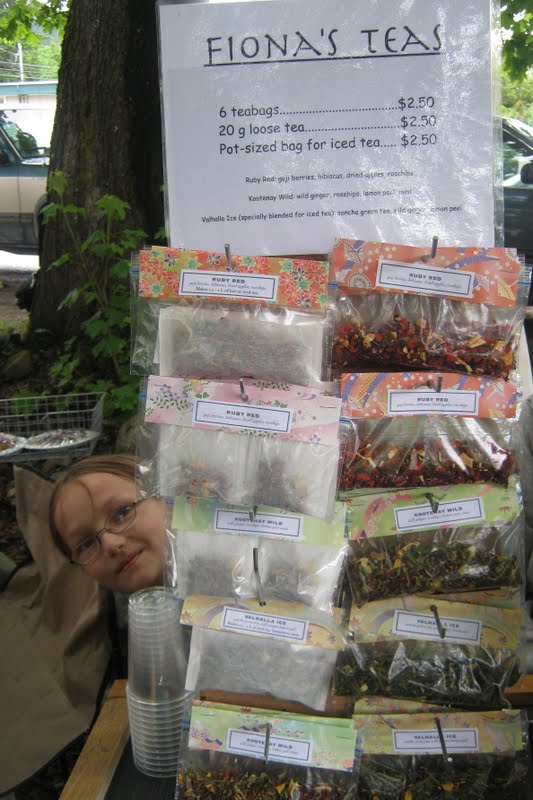
Fiona ramped up her tea production this week. She is completely self-sufficient at mixing, weighing, heat-sealing the bags, and packaging. She gets help from me printing the labels from my desktop publishing program and punching the holes in the top (her hands aren't strong enough to work the hole punch).

New this week for her is this display stand. It's just a piece of scavenged pressboard with some holes drilled in it for wire pegboard hangers. Stuff we found in the bottomless pit of Chuck's hoardings of home repair stuff in the shop. And now she has a lovely vertical display which does her lovely packaging justice.

The easy pickings of wild ginger are almost over for the year, so she is beginning to think about the next tea blend. Lots of herbs are growing in the garden, but they're nowhere near ready for harvest yet. So she's considering some fruity blends and wild-crafted wellness teas. We have a huge collection of wild rose petals and dried rhubarb, some red clover, mint and nettles. We also have some organic ingredients we've purchased: sencha and white peony teas, red rooibos, vanilla bean pods, coconut and other toasted nuts, chamomile, orange and lemon peel. The possibilities are endless!

Thursday, May 19, 2011

Tea progress

Fiona's tea business is taking shape. Some organic ingredients have been purchased. These have been combined with wildcrafted ingredients like rosehips, peppermint and wild ginger. The wild ginger in particular has entailed several trips along trails for collecting but we now have heaps of the stuff.

Two herbal blends are shown. On the left is Ruby Red, a combination of hibiscus, goji berries, dried apples and rosehips. On the right is the Kootenay Wildcraft tea, a blend of wild ginger, rosehips, peppermint and lemon peel.

This morning the teabags arrived!  We'd ordered 500 heat-sealable teabags. She will sell some tea loose-leaf, but most of it will go into teabags. Two grams of tea goes inside each bag, and then a few seconds with the iron along the open edge seals it up for good. She enjoyed making up a few today.

Next she's going to have to figure out packaging. She could just put 10 teabags in a ziploc bag, but somehow that seems a little conventional and dreary. She's had thoughts about labels and origami boxes.

In the meantime, it's fun to test out the teas, and to serve them up to guests for feedback. The Ruby Red is really lovely to behold in a glass cup.

And she's carefully tending all sorts of other herbs in flats and in the garden: lemon bergamot, peppermint, marigold, chamomile and lemon balm are growing, and lavender and anise hyssop starters are on their way to us by mail.

Friday, May 13, 2011

Making hard candy

Here is Sophie's system for making hard candy. Her basic recipe is from the LorAnn Oils site. They make great concentrated oils and dozens of awesome flavourings, though natural foods stores are a good source of basic essential oils as well.

Ingredients

2 cups granulated sugar
2/3 cup corn syrup (use clear or amber as desire: only colour will be affected)
3/4 cup water
5 – 15 drops of liquid food colouring
1 tsp. essential oil or other concentrated flavouring (use half as much for clove, cinnamon or peppermint oil)
For dusting: 1 cup of icing (confectioner's) sugar

Equipment:
Small to medium sized clean, heavy-base pot with heat-proof handle and lid. (Mixture will bubble up to approximately twice its initial volume, so you need to have a good bit of room to spare.)
Accurate candy thermometer (We use our laser infrared digital thermometer which works great but a decent analogue one will suffice.)
Heat-proof spatula
Molds (sprayed with light cooking oil) and lollipop sticks if desired
Dough scraper (lightly oiled)
Marble slab or other heat-proof surface (lightly oiled)
Heavy-duty scissors or kitchen snips (lightly oiled)
Pan or rubbermaid container in which to toss candies in icing sugar
Basic metal kitchen sieve
Damp cloths for quickly wiping up spills.
A source of water for rinsing hands as needed.
A well-organized workspace that will not risk a person carrying a pot full of extremely hot sticky syrup tripping over a child, a stool or a dog whilst moving to counter area to pour candy.

The beginning of the Butter Rum candies
Place granulated sugar, corn syrup and water in the pot. Stir gently just enough to dampen the sugar. Put the spatula aside and resist any temptation to stir again until mixture is done cooking. Heat on medium heat on stove until mixture starts to simmer. Put the lid on the pot and let it simmer away covered for a couple of minutes at least. The condensation on the sides of the pot will was down any lingering sugar granules and help prevent crystallization later on. Remove lid.

Monitor temperature periodically as the mixture boils. It will likely hang around 212ºF (100C) for a while until the water boils off and then beginning climbing gradually. The rate of increase may increase as the temperature increases, so be vigilant. 

A deep red for Cinnamon candies
At 260ºF (125C) add drops of liquid food colouring as desired. Just sprinkle them on the boiling syrup. Don't stir! The boiling action will mix the colour in.

As soon as the syrup hits 300ºF (150C) turn off stove and remove pot from heat. Wait for boiling to subside. Measure out your flavouring and pour on top of syrup. Use spatula to stir it in. Warning: some flavourings, especially the natural oils, let off a lot of harsh sinus-penetrating volatile aromatic hydrocarbons. Stand back while stirring!

Lovely shiny ribbons
Pour one to three ribbons of syrup onto your heat-proof oiled surface and then place saucepan back on stove on lowest heat to keep remaining syrup liquid. Don't touch the ribbons at first. 

Use dough scraper to fold them over on themselves once or twice. After they begin to hold a more rolled, three-dimensional shape, they are ready to start handling. 

Work quickly! Touch lightly with clean hands and keep your hands and the candy ribbons moving so as to avoid burns. We like to twist ours a dozen or so turns and then roll the twisted rods like snakes a bit between our palms to compact them. 

Snip into candy-sized lengths into icing sugar while still warm and pliable. Toss to cover with icing sugar. Repeat until all the syrup has been turned into candy. Sift off excess icing sugar.

Alternatively you can pour all your syrup onto a rimmed cookie sheet lined with lightly oiled foil, wait a couple of minutes and score your clear lake of candy into bite-sized bits with the back of a lightly oiled dinner knife. If the scores fill in, the candy is still too hot: wait a couple of minutes and repeat. Allow scored candy sheet to cool completely, then break into bits along the scoring lines.

Sophie gets three beautiful lollipops and this
many candies from a single batch
Or you can use lightly-oiled candy molds. (Not the kind made just for chocolate: they won't stand the high heat of this syrup. You need the kind intended for hard candy.) Pour. Cool. Turn out.

Candy should be stored in a cool dry area, inside something moisture-proof.

Wednesday, May 11, 2011

Candy shop

Sophie has been busy making candy. From left to right:

Root beer, mint, anise, maple, tangerine and lemon.

Next up: butter rum, raspberry and cinnamon.

She's also making lollipops which are turning out very nicely. She can do three large lollipops from each batch of candy, leaving the quantity shown in the lemon drop jar for lozenges. Each batch takes about 45 minutes from start to finish, including clean-up.

Thursday, May 05, 2011

Cheep, cheep, cheep, cheep

Our new batch of Ameracauna chicks arrived via the post office this morning. While we had had success breeding our own stock in the past, we lost all our chickens when we left the homestead undefended by both human and dog while Sophie's appendix was bursting on our non-vacation last year.

So we're starting from scratch again, if you'll pardon the pun. This batch is nicely varied in colour with a number of lovely coppery chicks as well as the standard yellow-black stripey sort. Our basement is full of cheeps and chirps and it glows with the red of the heat lamp.

Saturday, April 30, 2011

More market research

Now it's Fiona's turn. She has been persistent in her desire to create teas to sell at the market this summer. So far she's working on two blends.

The first is a tropical chai featuring organic black assam tea, red pepper flakes, toasted coconut, cardamom and cinnamon. Don't snicker: it's inspired by a boutique tea blend we love and Fiona's version 2.0, with the cinnamon toned down, is remarkably good.

The second is well on its way to being a winner. It's a Kootenay herbal blend based on wild ginger and rose hips. It needs some citrusy overtones, and so far she's used lemon peel; ultimately the hope would be to use organic lemon balm from our garden, but with the snow just barely gone it isn't exactly ready for harvest yet. I think it might also benefit from a hint of our peppermint, but we'll see. The wild ginger was fresh-picked in the forest today, but we went through the bother of drying it to test out how it would retain its flavour and release it in the tea. It works really well with the rose hips.

Friday, April 29, 2011

Sophie's Sweets

The Friday Market in town will be starting up again soon, and Sophie has identified a market niche that she wishes to fill. She has been busily researching candy-making and doing various experiments. She decided that although kids would probably buy a few lurid-coloured lollipops at a dollar apiece, there's likely a broader market to be tapped into if she appeals to adults meandering around appreciating the quaintness of the market and the simplicity of its mostly natural products.

So her plan is to focus on old-fashioned hard candy, using simple and mostly natural ingredients: sugar, corn syrup, natural flavours where possible and a bit of vegetable-based colouring where warranted.

She's made three test batches so far. The first proved definitively that our candy thermometer is not accurate unless deeply immersed in large-volume recipes: some heavily carmelized (i.e. somewhat burnt) peppermint candies were the result. The laser thermometer has been perfect. The root beer flavouring produced a divine result, and though the maple she tried today was a little too subtle (add more next time!) it otherwise worked nicely. We've tried a few approaches to shaping the candy. So far the best method, in that the syrup remains workable long enough for a 12-year-old to complete production, is to drizzle it in powdered sugar, let cool slightly, then roll, twist and snip the cooling candy into individual pillow-shaped candies. The final product has a nice, rustic look to it that fits with her marketing plan.

Today she and I have been talking about and experimenting with packaging and presentation options. Kraft paper gives a nice look, I think. Wetted down it can be easily tied over old jar lids. The matching labels look lovely. The smaller 8 oz. jar shown in the photo is about the right size for a large gift jar and holds about 170 gm of candy. She'll also need smaller jars: we hope to recycle 4 oz. baby food jars. We have a pump'n'seal thingummy that does a great job of evacuating air from jars and sealing out the moisture that makes the candies get sticky and soft over time. So far the jars we've sealed have kept their candy nice and dry even in our warm humid kitchen.

Fiona's plan is to blend loose-leaf herbal teas and exotic chai blends to sell at the market. She is hoping to grow a lot of herbs and before too long we will be heading into the forest in search of wild ginger to harvest.

Friday, April 15, 2011

Car Free Day

I wonder why we haven't done this in forever?

The Sienna gets a day off to enjoy the spring-like sunshine.
Our biggest challenge in trying to reduce our environmental footprint has always been in the realm of transportation. We live miles (or depending on how you define it, hours of miles) from anything. There is no public transit to speak of here. One day a week, which is the wrong day for us for any number of reasons, if you have the entire day to spare, there's a bus that will get you to Nelson and back. But we've never been able to use it. Buses to Calgary, which Erin does make use of regularly, require us to make a 6-hour round-trip drive just to get her to or pick her up from the bus station: and cost almost double the price of gas to drive the whole distance in the van. And even the short distance to town (3.4 kilometers to get to the top of main street) is along a winding mountain highway with scanty shoulders, with a 6-8% grade. It's not a walk for the faint-of-heart.

As anyone who reads this blog will know, our village of 600 has a lot going for it, but when it comes to several of the things that my kids are interested in there simply aren't the numbers and activities here to support them. So we travel a lot. Playing a soccer game against another team requires a 40-minute drive. The aikido dojo we were a part of was 30 minutes south. Corazon Vocal Ensemble rehearses 90 minutes away. And of course violin and viola lessons for the older two are 8 hours away in Calgary.

So we drive. A lot. Thirty thousand kilometres a year, at least. And feel guilty about it. Six years ago we bought our minivan with an eye to fuel efficiency. (Passing on the 4WD model was a probably short-sighted choice made primarily to reduce fuel consumption.) But it's a minivan nonetheless and it runs on fossil fuels.

Today we didn't drive. Today we decided to be car-free in order to remind ourselves how much we depend on the vehicle, how much we appreciate its convenience and instant gratification it affords. (Out of milk? Wondering if anything interesting came in today's mail? Drive to town! Go back later for something else...)

Wild turkeys, seen crossing the highway yesterday
The three younger kids and I had a meeting at the school with our DL program liaison teacher this morning. We had a bunch of projects, books and bookwork to bring and show off, so we packed them in a backpack and headed out. There was snow on the ground at home, but out on the highway things were clear and dry. We had hoped we might run into the turkeys again today but alas while Sophie heard some gobbling in the woods, they weren't out in plain sight.

We arrived perfectly on time, the walk taking about 43 minutes (downhill being much the quicker direction). While Noah was finishing up his part of our meeting, the girls went to the Post Office and picked up the mail. We went to the bank and then to our favourite café for lunch. Then we headed home, which took about an hour.

After we got home, Erin, who had stayed home practicing for the morning, went to the gym. She jogged down, did her couple of hours of working out, and then power-walked and jogged back home, for a total of about three hours of exercise.

In the meantime the three younger kids had eaten supper and we had given their bikes a spring tuning. They rode off to Gaming Night, a Friday night occasion not to be missed. Held at one of the community halls, this is a chance for kids and adults who enjoy playing computer and video games to get together and play in real time and real space in a social atmosphere. There are 4 or 5 reconditioned computers, plus the organizer's own couple of machines, plus a console game platform or two hooked up to a TV (most recently the Xbox Kinect which my kids love). For the first three hours the games are all rated "E" for Everyone and all kids are welcome. After 9 pm it's mature gaming time targetted at teens and adults (slightly younger kids can stay with parental permission) so all the younger kids leave and the older ones stay on or drift in. Noah attends the entire six hours if he can manage it, and has become kind of the Assistant Tech Guy, granted full admin privileges and recently taking most of the responsibility for selecting and installing games for the pre-teens.

So the kids rode their bikes down and have ditched them at grandma's house for retrieval tomorrow. I'll head out in time to pick Fiona up at 9 o'clock. I'll bring four head-lamps and some water and leave half of my supplies with Sophie and Noah. I'll walk home with Fiona. At a few minutes before midnight, as Gaming Night is shutting down, Noah and Sophie will don their own head-lamps and start hoofing it up the hill. They are have pointed out that according to their logic Car Free Day ends at midnight and that therefore I will be there in the minivan to pick them up before they get too far up the hill. Depending on how cold and spooky my walk home with Fiona between 9 and 10 turns out to be that may indeed be the case. Then again Fiona will have self-transported a total of 15 km today, most of that on foot; should Noah and Sophie really be rescued after 11.5 kilometres? We shall see how benevolent the owner/operator of Mom's Taxi Service is feeling at midnight.

All in all they've taken to it without complaint and with the spirit of adventure and appreciation that it was intended to nurture.

Oh, and Chuck is off at a conference for a few days. We had a feeling he wouldn't have been willing to play along (as his lack of appreciation and respect for No-Screen Days in the past has suggested), so this Friday was chosen strategically to avoid the issue of paternal non-compliance.

Sunday, January 16, 2011

A Nook for Sophie

Our home was originally built as a 15 by 30-foot log rectangle with vaulted ceilings and two rooms. It's seen three separate additions over the years, the largest and latest of which was ours, put on when Noah was an infant. But the main living part of the house is still that log rectangle with the vaulted ceiling.

At some point, probably very early on, whoever built the place decided that a loft would give some much-needed storage space. So they slung a low ceiling over the larger of the two rooms and created a crawl-space of a loft above. The engineering is rather interesting. We assume it's safe, since it's lasted several decades already without incident. The floor of the loft isn't supported on proper joists as far as we can tell. Part of the load is taken by the roof joists, through a funky arrangements of chains and turnbuckles. It's not pretty but it seems to work.

Anyway, Sophie has been craving a bit more privacy and quiet for her academic work. From her perspective I don't think Erin can move out soon enough. She would love a quiet room into which she could retreat for reading, bookwork or just chilling out. But not only does she share a bedroom with Fiona, but that bedroom is so tiny that there's barely room for the bunk bed and clothes. You can hardly walk around the bed without shuffling your body along sideways. So there certainly isn't any space for a desk.

So we looked at the loft. It was packed full of junk. The remains of hobbies past, broken furniture, baby clothes, toys for toddlers, craft supplies no longer desired, projects built by younger children, archived sheet music, medical diplomas, Christmas decorations, photographic slides, I'm sure you can imagine. We spent some time organizing, reshuffling, recycling, tossing. And we ended up with a nook just big enough for a kneeling desk made out of two IKEA Trofast bins (still containing their Playmobil castle parts and Brio train bits) and a piece of plywood. It's a little bit like Harry Potter's cupboard under the stairs, but hey, it's warm -- the heat from the wood stove rises, of course -- and it works for her.

She has her dad's old laptop up there to do Rosetta Stone French, her math book, her science textbook and workbook, some writing utensils and Larry Gonick's "Cartoon History of the Universe" series. Fiona's jealous. We'll be working on her nook next. It will be even smaller and with even less head room. Small living, growing kids, it has its challenges.

Sunday, December 26, 2010

My blacksmith

Look what my personal blacksmith got me for Christmas! It's a special tool which attaches to the angled lip of my new baking sheets to allow me to insert and retrieve bread from the oven without further singeing the faux-fur on my winter jacket, or my eyebrows for that matter. He custom-made it for me, and it works perfectly.

It's particularly well-suited to making little foccaccia breads for Christmas-leftover sandwiches which he can grill on the panini press I gave him. Love that tidy convergence.